After understanding the fundamentals of oil management, the next essential concept for any professional kitchen wanting to dive deeper into oil management is TPM: Total Polar Materials.
TPM is a measurement, and one of the most widely used in commercial kitchens to monitor frying oil quality during operations, and decide when to refresh or replace fryer oil.
It is a cornerstone of modern oil management strategies, and it is expressed in percentage (%).
What is TPM (Total Polar Materials)?
TPM stands for Total Polar Materials, sometimes also referred to as Total Polar Compounds (TPC). It represents the percentage of degraded, polar substances that accumulate in frying oil as a result of heat, oxygen, water, and food contact over time.
During deep-frying, the fresh triglycerides (the intact molecules making up fresh oil or frying fat) gradually break down through oxidation, polymerisation, and hydrolysis, producing a mix of unwanted degradation compounds, collectively named Polar Materials.
What does the term Polar Materials include:
-
- Free Fatty Acids : unstable and reactive elements released by oil molecules
-
- Mono- and Diglycerides : partially broken oil molecules that increase polarity and speed up ageing
-
- Oxidative Degradation Products (Aldehydes, Ketones) : reactive by-products from oil oxidation
-
- Polymerised Triglycerides : Heat-linked fat molecules forming heavy chains
All of these degradation products are more polar than fresh oil and are therefore grouped together under the TPM value.
In simple terms: TPM shows how far frying oil has progressed along its degradation lifecycle.
How is TPM Measured in Practice
In laboratory settings, TPM is measured using column chromatography, an accurate, but complex and slow solution, unsuitable for kitchen operations.
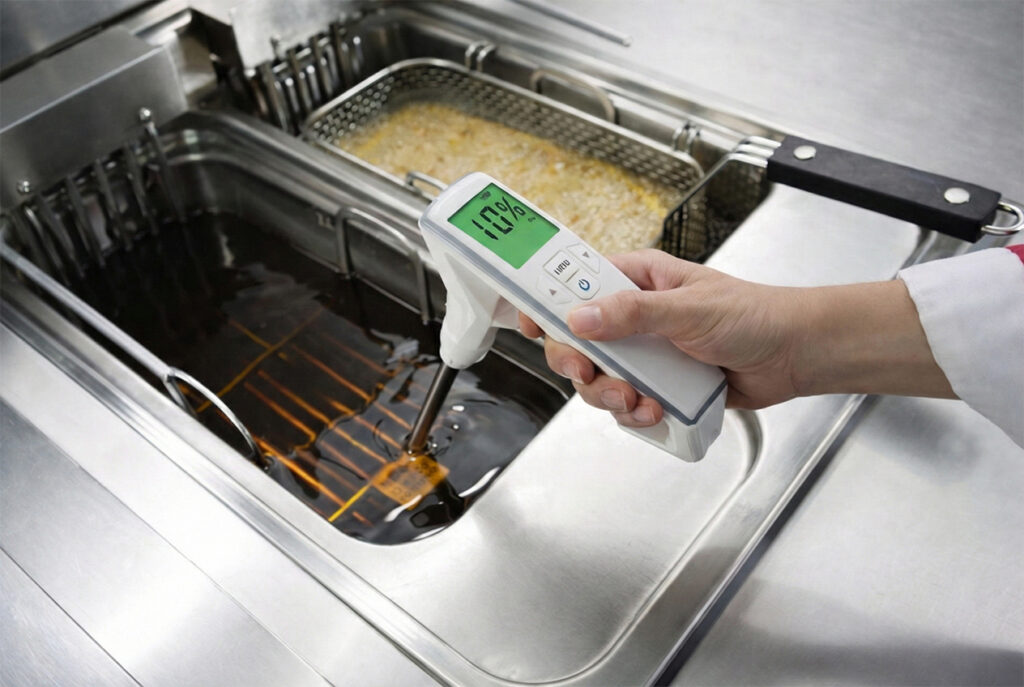
In real operations, TPM is measured using capacitive sensors (handheld TPM meter), also called TPM Measurement Device or more commonly “frying oil tester”. The measurement is done on-site, directly in the fryer and in hot oil.
This enables live monitoring, structured logging, and immediate corrective action, making TPM measurement compatible with HACCP control and documentation requirements.
This is why TPM is considered the most practical, objective, and repeatable on-site indicator of frying oil degradation.
Why is TPM Important in Oil Management
-
- What the TPM index reflects
TPM is particularly valuable because it reflects the cumulative ageing of oil, not just one isolated chemical reaction.
As TPM increases, frying oil in the kitchen will typically show:
-
- Higher viscosity and poorer heat transfer
-
- Lower smoke point, and oil producing fumes
-
- Faster browning but higher oil uptake in food
-
- Drier products with hollow interiors (e.g. fries)
-
- Degraded flavour and aroma
-
- Increased formation of undesirable compounds
All the well-known bad stuff to experienced kitchen staff, signaling when oil is “dead” and needs to be replaced. The type of signs you do not want to start your shift with.
This direct relationship between TPM, oil performance, and food quality is why TPM has become the reference parameter in many European countries for determining when frying oil must be refreshed or replaced.
-
- TPM Reading and the Frying Oil Life Cycle
As a rule of thumb, this is an easy way to read the TPM measurement :
1–14 % TPM → Fresh or lightly used oil
14–20 % TPM → Used but still acceptable
20–24 % TPM → Heavily used, replacement recommended
> 24 % TPM → Oil no longer fit for consumption
In most countries where TPM regulation is present, the legal limit varies between 24 and 27%.
-
- TPM in a Total Oil Treatment (TOT) Strategy
TPM measurement is an indicator, not a solution in itself, and should never be used in isolation.
Within a Total Oil Treatment (TOT) approach, TPM monitoring works together with:
-
- Temperature discipline
-
- Filtration frequency
-
- Oil refreshing strategies
-
- Oil chemistry optimisation
-
- Staff training and measurement routines
This is where advanced oil-management solutions (such as Beyond Oil) add value to a tight TOT strategy: not by replacing TPM measurement, but by slowing the rate at which TPM increases, and using the flexibility given by this agile and on-site measurement to extend oil life while maintaining consistent food quality.
Frying oil does not degrade linearly. Multiple variables influence its lifecycle. Effective oil-management discipline, combined with solutions like Beyond Oil, can flatten the TPM curve, slowing degradation from fresh oil to spent oil, rather than merely reacting once limits are reached.
TPM Is Critical, But Not the Whole Picture
TPM measurement is one of the most useful operational tools for controlling frying oil quality, but it is important to understand its limitations. TPM provides a cumulative snapshot of oil degradation, making it highly effective for real-time decision-making in professional kitchens. However, it does not describe individual chemical compounds, nor does it offer a complete nutritional or toxicological profile of the oil.
For that reason, TPM should be understood as a control indicator, not as a comprehensive assessment of oil health.
TPM is one indicator. Other tests exist, but most require lab analysis, like FFAs and Trans-Fats for instance.
TPM vs Free Fatty Acids (FFA)
Free Fatty Acids (FFA) measure a specific degradation pathway linked mainly to hydrolysis. FFA analysis can be useful for evaluating fresh or stored oils, but under active frying conditions, FFA levels fluctuate significantly due to evaporation and ongoing reactions. This makes FFA poorly suited for in-service oil control, where stable, repeatable measurements are required.
TPM vs Trans-Fats and Laboratory Analysis
Other parameters, such as trans-fat content or specific oxidation by-products, can only be assessed through laboratory analysis. While valuable for research, regulatory verification, or nutritional studies, these methods are not designed for operational control, as they require sampling and delayed results.
TPM is therefore best understood as a dashboard indicator: it does not explain every detail of oil chemistry, but it provides a clear, actionable signal that allows kitchens to monitor degradation trends, make timely decisions, and integrate oil management into structured practices and treatment solutions.
INNOVEA’s Approach
At Innovea, we view Oil Management as an expertise that every kitchen staff member can acquire. Awareness, observation, knowledge about oil, its life cycle and its degradation, are vital tools to ensure an ideal positioning between product quality, health and cost-efficiency.
Our approach is to help kitchens keep oil quality and frying rendering as close as possible to its fresh state for as long as possible, rather than aiming for a predefined “optimal degradation window”. Through structured oil-management practices coupled with science-based approach and tools, you will be able to slow the formation of polar degradation compounds, to reduce oil stress and to maintain stable frying behaviour.
In this regard we see TPM measurement as another decision-support tool, a quantitative science-based one, not a target to optimise towards degradation. Its precision and the array of factors it covers confer a great amount of flexibility and agility to the kitchens willing to equip themselves with a TPM Measurement Device.
The Bottom Line
TPM is not about changing oil earlier or later, it’s about changing it at the right time.
Used correctly, TPM measurement helps food businesses:
-
- Serve consistently better fried food
-
- Reduce oil waste and cost
-
- Improve food safety and compliance
-
- Gain objective control over oil ageing
For any kitchen serious about oil management, TPM is not optional, it’s foundational.